I love fish-out-of-water stories. Lately I’ve been musing on my own growing-up years, and I think I had a little break-through as to why I love that kind of story.
My dad spoke fluent Spanish and often talked to me about the Cuba of his childhood. When I would visit my grandmother and grandfather, I was guaranteed that, at some point, the talk would circle back to Cuba. How much they missed Habana, guayaba, lechon. How much they would give to be able to visit. (This was the 70s. Visiting Cuba was not happening.)
My dad spoke fluent Spanish and often talked to me about the Cuba of his childhood. When I would visit my grandmother and grandfather, I was guaranteed that, at some point, the talk would circle back to Cuba. How much they missed Habana, guayaba, lechon. How much they would give to be able to visit. (This was the 70s. Visiting Cuba was not happening.)
I loved their stories, and I loved when Grandmommie called my granddad “Papi,” or when she got out the Cuban school books for me to read, or when she taught me what the words meant, or prepared plátanos using crushed Saltine crackers (probably tortitos de plátano, but this is a recipe I never got. I don’t think she ever wrote it down.)
I have a snapshot of my dad, my aunt, and my grandmother on a boat between Miami and Habana. The pictures I have of Cuba are mostly faded to funny colors, although I guess blue isn’t entirely wrong for the ocean.
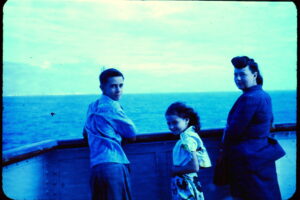
April 14, 1948
Growing up, I assumed I was Cubana or at least Cuban-American, and I distinctly remembering girl-splaining to a boy at the bus-stop that Cubans could totally have blue eyes and light-colored hair and that I did too know Spanish. (Not much, but how much English do you know when you’re nine?)
At some point in my teens, I realized that my beliefs about Who I Was were wrong. To this day it gives me a sinking feeling to remember how crushed and confused I was when I discovered I wasn’t Cuban. Like, not at all. My dad’s family had lived there, yes, but none were born there, and all returned to California before Castro took power.
I never felt quite right in my skin after that. I didn’t know what to do with the part of me that identified with the Spanish-speaking students and teachers in mi comunidad. In my community-that-wasn’t. In central Cali, it was easy to find friends who spoke Spanish. And if their abuelas cooked tortillas instead of maduros, well, that was kind of interesting. I liked learning about Mexico and its cooking traditions. We were sort of like second cousins, us Cuban-Americans and Mexican-Americans.
So maybe this is why I love to tell stories about characters who wake up one day and find the carpet has been pulled out from under them? Who grew up in one place and are unexpectedly in another?
For whatever reason, those are the stories I gravitate toward. From Jessamyn of Mars, stuck on Earth, to Edmund the Second Earl of Shaftesbury, stuck in 21st century Santa Barbara, these are what I like to explore.